A mixed flow pump is a type of dynamic pump that moves fluid using a combination of centrifugal force and axial thrust, positioning it functionally and hydraulically between a purely centrifugal pump and a purely axial flow pump. The impeller of a mixed flow pump is designed so that fluid enters axially — parallel to the shaft — and exits at an angle that is neither fully radial nor fully axial, but diagonally outward. This hybrid flow path gives the pump its defining characteristic: the ability to handle moderate to high flow rates while still generating meaningful head pressure, a combination that neither centrifugal nor axial designs can achieve as efficiently on their own.
The specific speed (Ns) of a pump is the single most useful parameter for classifying pump types and predicting their behavior. Centrifugal pumps operate at low specific speeds (Ns = 500–3,000 in US customary units), axial flow pumps at very high specific speeds (Ns = 9,000–15,000), and mixed flow pumps occupy the intermediate range of Ns = 3,000–9,000. This specific speed range corresponds precisely to applications where large volumes of water or fluid must be moved against moderate heads — irrigation canals, storm drainage systems, municipal water supply lift stations, cooling water circuits, and flood control infrastructure. In these situations, a centrifugal pump would require an impractically large diameter to achieve the necessary flow rate, while an axial pump could not generate sufficient head. The mixed flow pump solves this engineering dilemma elegantly through its intermediate impeller geometry.
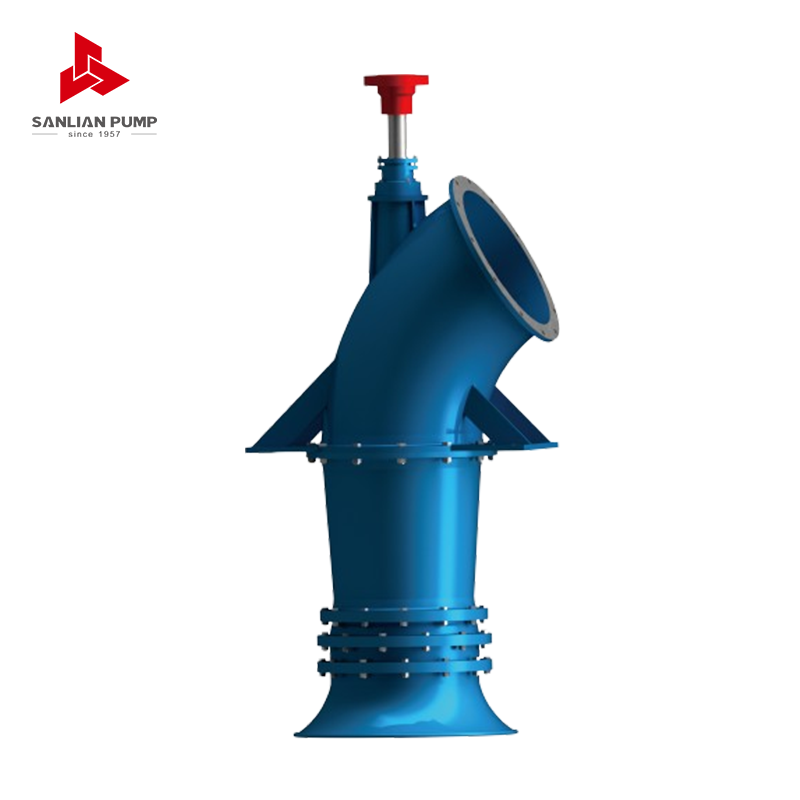
Mixed Flow Pump Working Principle Explained
Understanding the working principle of a mixed flow pump requires examining the mechanics of how the impeller interacts with the fluid and how that interaction translates kinetic energy into pressure and flow. The process involves several sequential stages that collectively move fluid from the inlet to the discharge with high efficiency.
Fluid Entry and Axial Inlet Conditions
Fluid approaches the mixed flow pump impeller axially through the suction inlet, which is typically bell-mouthed or shaped as a converging passage to accelerate the flow smoothly and minimize inlet turbulence and vortex formation. The impeller blades are carefully profiled with a leading edge angle designed to accept the incoming axial flow without significant incidence — the angular misalignment between the fluid velocity vector and the blade leading edge. Proper inlet design is critical because even minor flow separation at the blade leading edge can trigger cavitation, reduce efficiency, and cause noise and vibration that accelerate mechanical wear. The impeller hub-to-tip ratio at the inlet — a key geometric parameter — is set to distribute flow evenly across the blade span and prevent secondary flow recirculation near the hub or shroud at the design operating point.
Energy Transfer Through the Impeller
As fluid passes through the rotating impeller passages, it undergoes simultaneous centrifugal acceleration and axial momentum transfer. The impeller blades — typically 4 to 8 in number, with complex three-dimensional twist angles that vary from hub to tip — impart both a radial velocity component and an axial velocity component to the fluid. The fundamental energy transfer mechanism is described by Euler's turbomachinery equation: the energy added per unit mass is proportional to the change in the product of tangential blade velocity and fluid tangential (whirl) velocity between the impeller inlet and outlet. In a mixed flow impeller, both the centrifugal pressure rise (from the radial component of flow) and the axial momentum change (from the axial component) contribute to the total energy imparted to the fluid. The ratio of centrifugal to axial contribution is determined by the impeller's cone angle — the angle between the meridional flow path and the shaft axis — which typically ranges from 30° to 60° in mixed flow designs.
Diffusion and Pressure Recovery in the Casing
Fluid leaving the mixed flow impeller carries significant kinetic energy in both the tangential (whirl) and meridional directions. This kinetic energy must be efficiently converted to static pressure in the diffusion stage downstream of the impeller. Mixed flow pumps use one of two diffusion arrangements: a vaned diffuser, which consists of stationary guide vanes arranged annularly around the impeller exit that smoothly redirect and decelerate the swirling flow, or a volute casing, which collects the flow from the impeller periphery in a spiral-shaped passage of increasing cross-sectional area. Vaned diffusers are preferred in high-efficiency designs because they provide a more controlled, symmetric deceleration that minimizes losses, particularly at the design operating point. Volute casings are simpler and more tolerant of off-design operating conditions. In column-type mixed flow pumps used for deep well and vertical turbine applications, the diffuser bowl assembly typically consists of a cast vaned return channel that straightens the flow for the next stage or directs it into the discharge column pipe.
Role of Specific Speed in Defining Mixed Flow Pump Geometry
Specific speed is not just a classification tool — it directly determines the optimal impeller geometry through well-established hydraulic design relationships. As specific speed increases from the centrifugal to the mixed flow range, the impeller diameter decreases relative to the impeller width, the blade angles increase, the number of blades decreases, the hub-to-shroud cone angle increases, and the meridional velocity (the component of fluid velocity along the flow path through the impeller) increases as a fraction of the total velocity. These geometric changes systematically shift the dominant energy transfer mechanism from purely centrifugal (pressure rise due to the centrifugal effect on the fluid between the small inlet radius and large outlet radius) toward a combination of centrifugal and axial lift (pressure rise from the change in fluid momentum in the axial direction, analogous to the lift generated by an aircraft wing section). This is why mixed flow pump impeller blades are sometimes described as having a "propeller-like" twist at the tip and a "centrifugal-like" curvature near the hub.
Key Components of a Mixed Flow Pump and Their Functions
A mixed flow pump is an assembly of precisely engineered components, each contributing to hydraulic performance, mechanical reliability, and service life. Understanding the role of each component is valuable for maintenance engineers, procurement specialists, and system designers working with these machines.
- Impeller: The rotating element that transfers mechanical energy from the shaft to the fluid. Mixed flow impellers are typically manufactured from cast iron, bronze, stainless steel (316 or duplex), or engineered polymers depending on the fluid chemistry and abrasion requirements. The blade geometry is three-dimensionally curved and twisted, with blade angles at the hub and tip optimized independently to maintain uniform energy input across the full blade span. Impeller diameter typically ranges from 150 mm to over 1,500 mm for large drainage and irrigation pumps.
- Diffuser or guide vanes: Stationary vanes surrounding the impeller exit that convert the high-velocity swirling flow leaving the impeller into static pressure. In vertical turbine and borehole configurations, the diffuser vanes also serve the structural function of supporting the bowl casing and transmitting hydraulic loads to the outer housing. The number of diffuser vanes is typically one more or two more than the number of impeller blades to avoid hydraulic resonance at the blade passing frequency.
- Pump shaft: Transmits rotational torque from the driver to the impeller and supports the impeller radially and axially. In vertical mixed flow pump configurations, the shaft may extend several meters through the discharge column pipe to reach a surface-mounted motor. Shaft material is typically carbon steel, stainless steel, or high-strength alloy steel, and shaft diameter is sized to limit deflection and torsional stress to acceptable levels over the full operating speed range.
- Casing or bowl: The pressure-containing outer housing that guides the fluid from the impeller to the discharge. In horizontal mixed flow pumps, the casing is typically a volute or double-volute design. In vertical turbine configurations, the bowl assembly is a multi-stage arrangement of impeller chambers and inter-stage diffusers. Casing materials range from cast iron for clean water service to duplex stainless steel or polymer-lined steel for corrosive or abrasive applications.
- Mechanical seal or packing gland: Prevents fluid from leaking along the shaft at the point where it exits the pump casing. Single mechanical seals are standard for clean fluid service. Double mechanical seals with a pressurized barrier fluid are specified for toxic, hazardous, or high-temperature fluid service. Traditional packing glands using braided PTFE or graphite packing are still used in large irrigation and drainage pumps where some controlled leakage is acceptable and maintenance access is straightforward.
- Bearings: Mixed flow pumps use line shaft bearings (sleeve or rolling element type) to support the long rotating assembly, plus thrust bearings to absorb the net hydraulic thrust load. In vertical turbine pumps, the line shaft bearings are typically bronze or polymer-lined sleeves lubricated by the pumped fluid or by an external oil feed. Thrust bearings are located at the driver end and must be sized for the combined hydraulic and mechanical axial loads.
- Wear rings: Close-clearance rings at the impeller inlet and sometimes at the discharge hub that minimize internal recirculation from the high-pressure side back to the low-pressure inlet. Wear ring clearance directly affects pump volumetric efficiency — as clearance increases with wear, efficiency drops and more flow recirculates internally. Replaceable wear rings allow restoration of original clearances during maintenance without replacing the entire impeller or casing.
Mixed Flow Pump vs. Centrifugal and Axial Flow Pumps: A Practical Comparison
Selecting the correct pump type for a given application requires understanding how mixed flow pumps compare to their centrifugal and axial counterparts across the parameters that matter most in practice: flow rate, head, efficiency, cavitation behavior, size, and cost.
| Parameter |
Centrifugal Pump |
Mixed Flow Pump |
Axial Flow Pump |
| Specific Speed (Ns) |
500–3,000 |
3,000–9,000 |
9,000–15,000+ |
| Flow Rate |
Low to Moderate |
Moderate to High |
Very High |
| Head Generated |
High |
Moderate |
Low |
| Peak Efficiency |
70–90% |
80–92% |
85–92% |
| Typical Head Range |
5–3,000+ m |
3–80 m |
1–15 m |
| Cavitation Sensitivity |
Moderate |
Moderate–High |
High |
| H-Q Curve Slope |
Gradual, stable |
Moderate slope |
Steep, can be unstable |
| Typical Orientation |
Horizontal or vertical |
Vertical (common) |
Vertical or horizontal |
| Solids Handling |
Limited (standard) |
Moderate |
Good (open propeller) |
Performance Characteristics: Head-Flow Curve and Efficiency Behavior
The hydraulic performance of a mixed flow pump is fully characterized by its pump curve — specifically the relationship between total head (H) and flow rate (Q), and the corresponding efficiency (η) and power consumption (P) curves plotted over the full operating range. Understanding these curves is essential for correct system design, operating point verification, and predicting how the pump will behave when system conditions change.
Shape of the H-Q Curve and Stability
Mixed flow pump H-Q curves exhibit a characteristic moderately steep downward slope from shutoff head (zero flow) to the maximum flow point. The shutoff head — the head developed at zero flow — is typically 120–140% of the design point head, compared to 105–115% for centrifugal pumps. This means that when a mixed flow pump is started against a closed valve, it generates substantially higher pressure than its rated condition, which must be accounted for in pipe system pressure rating and valve design. At flows significantly above the design point, head drops steeply, making the pump sensitive to increases in system flow demand. The slope of the H-Q curve is important for parallel pump operation: two identical mixed flow pumps operating in parallel will each deliver approximately half the total flow at essentially the same head as a single pump, provided the system curve has a moderate resistance slope.
Efficiency Peak and Operating Range
Mixed flow pumps typically achieve their best efficiency point (BEP) at a relatively well-defined flow rate, with efficiency falling off more steeply toward lower flows than equivalent centrifugal pumps. This is because at low flows, internal recirculation develops at both the impeller inlet and outlet, creating significant hydraulic losses and raising the risk of cavitation-induced damage even when the NPSH available appears adequate. Operating a mixed flow pump continuously below 60–70% of BEP flow is generally not recommended unless the pump has been specifically designed for extended part-load operation with inlet recirculation suppression features. At flows above BEP, efficiency also drops and structural loading on the impeller blades increases, so operating above 120% of BEP should also be avoided in continuous service. The preferred operating window — often called the "preferred operating range" or POR — is typically 80–110% of BEP for mixed flow designs.
Power Curve and Motor Sizing Considerations
Unlike centrifugal pumps, which exhibit a rising power curve with increasing flow (the power at BEP is typically the maximum), mixed flow pumps display a power curve that may be relatively flat or even exhibit a maximum at an intermediate flow point before decreasing at very high flows. This behavior means that for mixed flow pumps, the motor must be sized not only for the design operating point but for the maximum power that can occur across the full operating range — which in some mixed flow designs is at a flow rate significantly above BEP. Failure to account for this in motor selection can result in motor overload and tripping during startup or when system head is lower than expected. Variable speed drives (VSDs) are increasingly used with mixed flow pumps to allow operation across a range of flow and head conditions while maintaining high efficiency, matching pump output to variable demand without throttling losses.
Primary Uses and Applications of Mixed Flow Pumps
Mixed flow pumps are the preferred choice across a broad range of industries and infrastructure applications wherever the combination of high flow capacity and moderate head is required. Their unique hydraulic properties make them indispensable in several sectors where alternative pump types would be either inefficient, oversized, or technically inadequate.
Agricultural Irrigation and Water Lifting
Irrigation is among the largest single applications for mixed flow pumps globally. Canal lift stations, river intake pumping stations, and field distribution systems for rice, sugarcane, and other water-intensive crops require pumps capable of delivering thousands of cubic meters per hour at heads of 5–30 meters — exactly the duty point where mixed flow pumps achieve peak efficiency. Vertical mixed flow pump installations at canal head works allow a single pump unit to lift water from a supply canal or river and deliver it into elevated distribution channels serving thousands of hectares of farmland. In regions with seasonal flooding and drought cycles, the flat system curves typical of large irrigation channels are well-matched to the relatively stable head behavior of mixed flow designs across a wide flow range.
Flood Control and Stormwater Drainage
Urban flood control systems and low-lying land drainage networks — including those in the Netherlands, Bangladesh, Louisiana, and coastal China — rely heavily on large vertical mixed flow pumps to rapidly evacuate stormwater from protected areas to receiving waterbodies. These applications demand maximum hydraulic reliability at the worst possible moment (during a flood event), very high flow rates (individual pumps rated at 5,000–30,000 m³/hour are not uncommon), modest heads (typically 3–15 meters), and the ability to handle water containing sand, debris, and vegetation without clogging. Mixed flow pumps with semi-open or open impeller configurations handle debris-laden floodwater far more effectively than multi-stage centrifugal designs, and their vertical orientation minimizes the wet footprint of pump stations that must be located within constrained urban or coastal environments.
Municipal Water Supply and Intake Pumping
Waterworks intake stations that pump raw water from rivers, lakes, or reservoirs to treatment facilities use mixed flow vertical turbine pumps extensively. The moderate suction lifts typical of these intake situations — where the water surface may be 3–8 meters below the pump discharge level — match well with the NPSH characteristics of mixed flow designs. Large municipal supply pumps rated at 500–5,000 m³/hour at heads of 20–60 meters are commonly supplied as vertical turbine bowl assemblies with mixed flow impellers in the lower stages and radial flow impellers in the upper stages, allowing multi-stage operation to reach the supply pressure required for distribution mains. The ability to house the hydraulic assembly below the water surface while mounting the motor and drive above the pump station floor simplifies civil engineering requirements and eliminates priming problems.
Power Plant Cooling Water Systems
Thermal and nuclear power plants require enormous quantities of cooling water to condense steam in their condensers. Circulating water pumps (CWPs) at these facilities handle flows of 30,000–150,000 m³/hour at heads of 10–30 meters — the archetypal mixed flow pump duty. These are among the largest mixed flow pumps manufactured, with impeller diameters of 1,000–2,500 mm and motor powers of 1–15 MW per unit. Reliability is paramount because a CWP failure directly removes the condensing capacity of a generating unit and forces an emergency shutdown with significant economic consequences. Modern CWP designs use computer-optimized impeller geometries derived from CFD analysis and are manufactured from high-strength stainless steel or duplex alloys to minimize corrosion and erosion in brackish or seawater cooling systems.
Industrial Process Cooling and Circulation
Steel mills, petrochemical refineries, desalination plants, and large data center cooling systems all employ mixed flow pumps for bulk liquid circulation duties where high volumetric throughput at moderate head is the defining requirement. In seawater reverse osmosis (SWRO) desalination, low-pressure seawater supply pumps feeding the high-pressure pump trains are typically mixed flow designs rated at hundreds to thousands of cubic meters per hour, sized to maintain adequate suction pressure at the high-pressure pump inlet across the full range of tidal variation and feed water temperature conditions. In steel plant cooling circuits, mixed flow pumps circulate mill cooling water through rolling mill stands and continuous casting equipment at flows of 1,000–10,000 m³/hour, often handling water with some suspended scale and mill oxide particles that would damage tighter-clearance centrifugal designs.
Aquaculture and Fishery Applications
Intensive aquaculture operations — salmon, shrimp, tilapia, and seabass farming systems — require continuous high-volume water circulation and aeration to maintain dissolved oxygen levels and remove waste products from growing tanks and raceways. Vertical mixed flow pumps with open impellers or axial-mixed designs are used in these applications because they can handle water containing fish feed, fecal matter, and juvenile fish with minimal damage, whereas closed centrifugal designs would cause unacceptable fish mortality from impeller strike. Flow rates of 500–5,000 m³/hour at heads of 1–8 meters are typical for recirculating aquaculture system (RAS) return water pumps. The gentle, low-pressure flow characteristics of mixed flow pumps are well-suited to the biological sensitivity of these systems.
Mixed Flow Pump Installation Configurations
Mixed flow pumps are manufactured and installed in several physical configurations, each suited to different civil infrastructure constraints, site conditions, and operational requirements. The choice of configuration has significant implications for pump station layout, civil construction cost, maintenance access, and reliability.
Vertical Turbine (Column) Configuration
The vertical turbine pump is the most widely used configuration for mixed flow applications in water supply, irrigation, and drainage. In this design, the bowl assembly (impeller and diffuser stages) is submerged below the water surface, connected by a column pipe of 1–30 meters length to a surface-mounted discharge head and motor. The shaft runs through the column pipe, supported by sleeve bearings at regular intervals. This arrangement keeps the motor above the flood level and eliminates the need for priming systems, as the impeller is always submerged. Vertical turbine pumps are the standard choice for pump stations with wet wells, canal intake structures, and sump installations where the water surface is below grade. They can be designed as single-stage (mixed flow bowl only) or multi-stage (combination of mixed flow lower stages and radial upper stages) to achieve required heads.
Submersible Mixed Flow Pump Configuration
Submersible mixed flow pumps integrate the motor and hydraulic assembly into a single waterproof unit that is fully submerged in the pumped fluid. The motor is hermetically sealed against fluid ingress and cooled by the surrounding pumped water or by a separate cooling jacket. Submersible configurations are preferred for deep sump or wet well applications where the installation of a long column pipe and line shaft is impractical, and for portable dewatering applications where the pump must be deployed quickly in flooded areas. Submersible mixed flow pumps are available in sizes from small portable drainage units of 0.75 kW handling 50 m³/hour to large permanently installed stormwater units of 300 kW delivering 15,000 m³/hour. The main maintenance consideration for submersible pumps is motor seal integrity — a failed motor seal allows water ingress that destroys the motor winding insulation, requiring either onsite seal replacement or complete motor removal and rewinding.
Horizontal Mixed Flow Pump Configuration
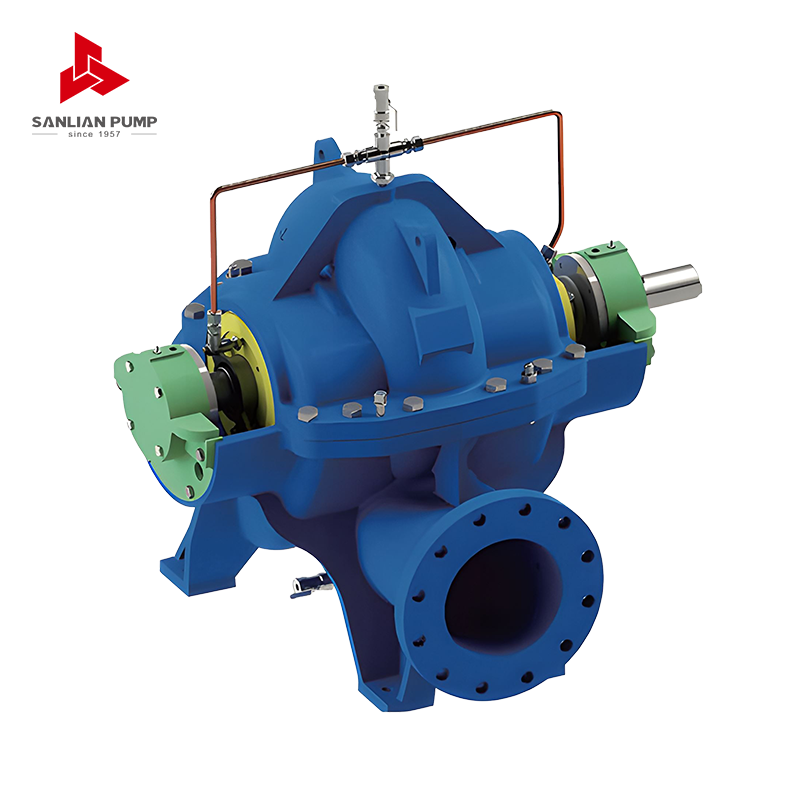
Horizontal mixed flow pumps are less common than vertical configurations but are used in specific applications where horizontal pipe runs are required and adequate suction head is available. The horizontal split-case configuration — in which the casing is divided along a horizontal plane to allow impeller access without disturbing the pipe connections — is favored for large cooling water applications at power plants and industrial facilities. Horizontal configurations require a suction source with sufficient positive head to fill the casing and prevent air entrainment, as priming a large horizontal mixed flow pump by vacuum means is impractical. They also require more floor space than equivalent vertical installations but offer easier impeller and seal access for routine maintenance without the need for lifting equipment to extract a column pipe assembly.
Cavitation in Mixed Flow Pumps: Causes, Consequences, and Prevention
Cavitation is the formation and violent collapse of vapor bubbles in a liquid when the local pressure drops below the fluid's vapor pressure. In mixed flow pumps, cavitation most commonly occurs at the impeller blade leading edges near the suction tip, where low pressure zones develop under certain flow conditions. The consequences of sustained cavitation range from noise and vibration to severe material erosion of the impeller blades — pitting and cratering that progressively destroys the hydraulic profile — and to sudden performance collapse if a large vapor cavity develops across the impeller inlet and blocks effective fluid entry.
Mixed flow pumps are more cavitation-sensitive than centrifugal pumps at equivalent specific speed because their higher flow velocities at the impeller inlet result in lower local pressures and higher NPSH requirements. The Net Positive Suction Head required (NPSHr) for a mixed flow pump at BEP is typically 2–8 meters, rising steeply at flows above BEP. Preventing cavitation requires ensuring that the NPSH available (NPSHa) at the pump suction flange — determined by the suction source pressure, suction pipe losses, fluid temperature, and elevation difference — exceeds NPSHr by a safety margin of at least 0.5–1.0 meter at all anticipated operating points. Additional protective measures include maintaining adequate submergence depth for vertical pumps (to prevent vortex-induced air ingestion at the suction bell), avoiding prolonged operation below 70% of BEP flow, selecting impeller materials with high cavitation erosion resistance (duplex stainless steel, bronze, or ceramic coatings), and monitoring pump vibration and noise as early indicators of developing cavitation before impeller damage occurs.
Maintenance Practices and Troubleshooting for Mixed Flow Pumps
Proactive maintenance of mixed flow pumps extends service intervals, prevents unplanned failures, and preserves hydraulic efficiency over the equipment's operational life. Given that many mixed flow pump installations serve critical infrastructure — flood control stations, water supply intake works, power plant cooling systems — reliability is as important as efficiency, and maintenance programs must reflect this priority.
- Vibration monitoring: Continuous or periodic vibration measurements at the motor and discharge head bearings provide early warning of impeller imbalance (from cavitation erosion, fouling, or mechanical damage), bearing wear, misalignment, and hydraulic instability. ISO 10816 defines acceptable vibration velocity limits for rotating machinery by power class and mounting type. Trending vibration levels over time is more informative than single-point measurements against absolute limits.
- Performance testing and efficiency monitoring: Periodic measurement of flow rate, head, and power consumption allows calculation of pump efficiency and comparison against the original factory test curve. An efficiency drop of more than 3–5 percentage points typically indicates increased wear ring clearance, impeller erosion, or mechanical losses from bearing degradation. Trending performance data allows maintenance to be scheduled before efficiency losses become economically significant.
- Wear ring inspection and replacement: At each major overhaul (typically every 3–7 years depending on service severity), wear ring clearances should be measured and compared to manufacturer specifications. Clearances more than 2× the original drawing tolerance significantly increase internal recirculation and reduce volumetric efficiency. Replacement wear rings are manufactured from materials harder than the impeller (e.g., stainless steel rings against a cast iron impeller) to ensure the rings wear preferentially and protect the more expensive impeller.
- Line shaft bearing inspection: In vertical turbine configurations, line shaft sleeve bearings must be inspected for wear, corrosion, and debris fouling at each overhaul. Water-lubricated rubber or polymer bearings used in clean water service require minimal maintenance but should be replaced if showing signs of glazing, grooving, or swelling. Oil-lubricated bronze bearings require periodic oil level checks and oil sample analysis for water contamination and metal particle content indicating abnormal wear.
- Mechanical seal maintenance: Mechanical seal faces should be inspected at every pump disassembly for wear, heat checking, and face flatness. Seal springs, O-rings, and secondary sealing elements should be replaced as a complete set at each overhaul regardless of apparent condition, as elastomer degradation is time and temperature dependent and failure of these elements causes sudden and total seal leakage. Seal flush piping and cooling water supply must be verified to be clean and free-flowing before reassembly.



 English
 中文简体
中文简体 Français
 Español
 Português
 عربى
عربى

 皖公网安备34052302341647号