The Engineering Challenge QW(N) Series Pumps Were Designed to Solve
Conventional centrifugal pumps are engineered for clean or lightly contaminated liquids. When the medium contains suspended solids, stringy fibrous material, or high concentrations of soft organic matter — as is consistently the case in municipal sewage, industrial wastewater, and agricultural drainage — standard pump impeller geometries clog rapidly, reducing flow, increasing power consumption, and ultimately requiring manual intervention to clear blockages. In continuous-duty sewage handling installations, this translates directly into unplanned downtime, maintenance labor costs, and the risk of wastewater overflow events that carry regulatory and environmental liability.
The QW(N) series submersible sewage pump series was developed to address this specific challenge through a combination of purpose-designed hydraulic geometry, robust mechanical construction, and installation-level engineering features that collectively eliminate the principal failure modes of conventional pumps in sewage service. The result is a pump family that operates reliably and with minimal maintenance in precisely the conditions where standard equipment fails most frequently.
Anti-Clogging Impeller Design: The Foundation of Reliable Sewage Handling
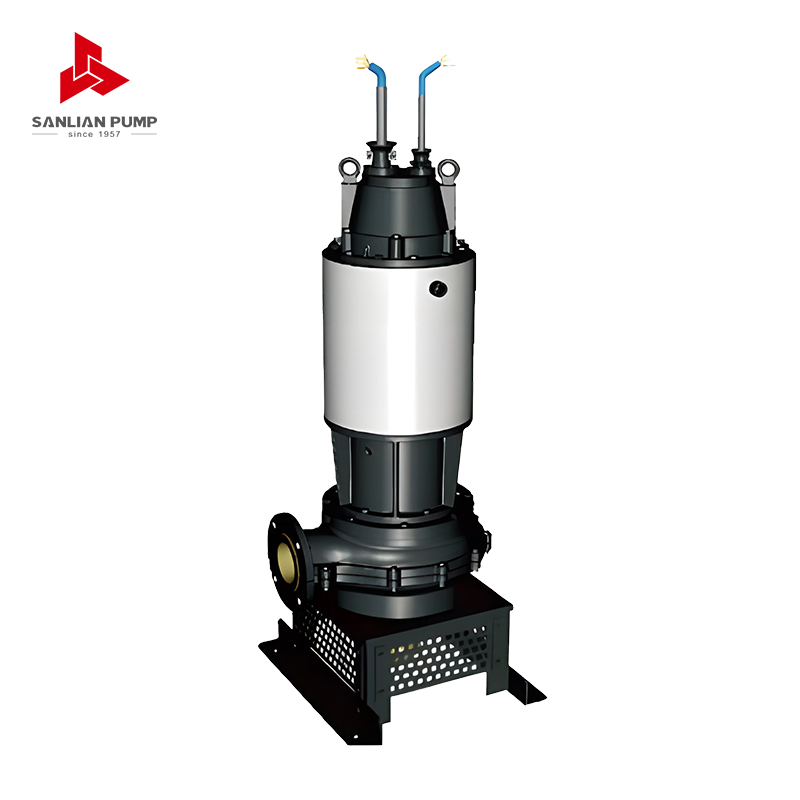
The hydraulic design of the QW(N) series impeller is the central engineering feature that differentiates it from conventional pump designs. Rather than the multi-vane closed or semi-open impellers used in standard centrifugal pumps — which create multiple narrow flow passages that solids and fibrous material readily bridge and block — the QW(N) series uses a specifically developed large-channel, non-clogging impeller geometry that provides several simultaneous operational advantages.
The impeller passage width is designed to accommodate solid particles up to a specified free-passage diameter — typically 30–80mm depending on pump model size — without retention or bridging at the impeller inlet or vane surfaces. Single-channel or double-channel impeller configurations are used depending on the model variant, with the channel geometry optimized through computational fluid dynamics modeling to maintain hydraulic efficiency while providing the required solids passage capability. This approach avoids the hydraulic efficiency penalty that earlier large-passage impeller designs suffered from in attempting to achieve clog resistance through simple clearance enlargement.
The QW(N) variant designation specifically refers to pumps with enhanced anti-winding design, where the impeller and volute geometry incorporates features that prevent long fibrous materials — textile fibers, plastic straps, grass clippings, and similar materials present in municipal sewage — from wrapping around the shaft or accumulating at the impeller inlet. Cutting edges or guide geometry at the impeller inlet break down or deflect fibrous material before it can establish the wrapped accumulation that eventually stalls conventional pumps.
High Hydraulic Efficiency Despite Solids Handling Capability
A frequent misconception in pump selection for sewage applications is that solids handling capability and hydraulic efficiency are mutually exclusive — that a pump capable of passing large solids must necessarily be inefficient compared to a pump designed for clean water. The QW(N) series challenges this assumption through careful hydraulic optimization that achieves competitive efficiency ratings while maintaining the large passage geometry required for reliable solids handling.
Depending on model size and operating point, QW(N) series pumps achieve pump efficiencies of 55–75% at the best efficiency point — a range that is fully competitive with many clean-water centrifugal pumps in the same power class and substantially better than the efficiency achievable with oversized pump selections made to compensate for clogging-related performance degradation in standard pumps. This efficiency performance directly reduces operating energy costs across the pump's service life, a factor that becomes highly significant in continuously running municipal sewage lift station applications.
The motor design is matched to the hydraulic end to maintain this efficiency across the intended operating range. High-efficiency motors with Class F insulation and IP68-rated sealed construction are standard, ensuring that the motor operates efficiently and safely in the fully submerged conditions typical of sewage wet well installations.
Auto-Coupling System: Eliminating Personnel Entry Into Wet Wells
One of the most operationally significant features of the QW(N) series installation system is the automatic coupling arrangement that allows the pump to be installed into and removed from the wet well without any personnel entry into the confined space — an operation that under manual pump installation procedures requires confined space entry permits, gas monitoring, and safety standby personnel, all of which create substantial procedural overhead and safety risk.
The auto-coupling system consists of a guide rail assembly permanently installed in the wet well and a coupling bracket on the pump body that engages automatically with a mating bracket at the base of the guide rail when the pump is lowered on its lifting chain. The coupling creates a watertight, mechanically secure connection between the pump discharge port and the fixed discharge piping without any manual fastening operations inside the wet well. Pump removal requires only lifting the pump vertically along the guide rails from the surface — the coupling disengages automatically as the pump rises.
This system reduces routine pump maintenance time from several hours (including confined space entry preparation) to 15–30 minutes of surface-level operations, with proportional reductions in labor cost and elimination of the confined space safety risk. For municipal operators managing multiple lift stations, this operational advantage over the service life of an installation represents a compelling total cost of ownership benefit beyond the pump's purchase price.
Automatic Level Control and Unmanned Operation Capability
The QW(N) series is designed for integration with automatic level control systems that enable fully unmanned wet well operation. Float switches, pressure transducers, or ultrasonic level sensors provide continuous liquid level signals to the pump control panel, which automatically starts and stops one or more pumps to maintain the wet well level within the programmed operating band — typically between a low-level cutout point and a high-level start point that provides surge capacity while preventing overflow.
For installations with duplex pump configurations — two pumps in the same wet well as is standard in municipal design for redundancy — the control system alternates lead and lag pump duty automatically, equalizing run-hour accumulation between the two units and ensuring that neither pump sits idle for extended periods without operation (which would allow bearing lubrication stagnation and impeller sediment buildup). Duty cycling based on pump run hours rather than fixed scheduling is available in advanced control configurations.
Remote monitoring integration via Modbus, Profibus, or 4G/GPRS telemetry allows pump status, run hours, fault conditions, and level data to be monitored from a central SCADA system — enabling a single operator to supervise multiple lift stations simultaneously from a central control room without site visits for routine status checks.
Technical Specifications and Application Scope
The QW(N) series covers a broad hydraulic range to accommodate the full spectrum of sewage pumping applications from small residential lift stations to large municipal collection system pump stations:
| Parameter |
Range |
Notes |
| Flow Rate |
5 – 3,600 m³/h |
Model-dependent |
| Total Head |
5 – 60 m |
Model-dependent |
| Motor Power |
0.75 – 200 kW |
Class F insulation standard |
| Max. Solid Passage |
30 – 80 mm dia. |
Impeller geometry determines |
| Max. Liquid Temperature |
≤ 60°C |
Standard motor rating |
| Motor Protection Rating |
IP68 |
Continuous submersion rated |
Representative technical specification range for the QW(N) submersible sewage pump series
Primary application areas include municipal sewage lift stations, industrial wastewater collection systems, hospital and hotel drainage, food processing plant effluent, construction site dewatering, and flood control pumping where debris-laden water must be handled reliably under continuous or emergency duty conditions. In all these contexts, the QW(N) series' combination of non-clogging hydraulics, anti-winding impeller design, auto-coupling installation, and automatic control integration provides a technically complete and operationally proven solution.


 English
 中文简体
中文简体 Français
 Español
 Português
 عربى
عربى

 皖公网安备34052302341647号