The Impeller's Role in Industrial Fluid Systems
In any pump-driven production process—whether in mining, chemical processing, water treatment, or manufacturing—the impeller is the single rotating component responsible for transferring mechanical energy from the motor into the fluid being moved. Every liter of slurry transported, every cubic meter of water circulated, and every kilogram of chemical solution delivered passes through or around the impeller. This makes impeller design, material selection, and operational condition the most direct levers available to engineers seeking to improve production output while controlling energy and maintenance costs.
Understanding how impellers improve production efficiency requires looking beyond the simple concept of "spinning faster equals moving more fluid." The relationship between impeller geometry, rotational speed, fluid properties, and system resistance is complex and highly specific to each application. Getting it right means more throughput, lower power consumption per unit volume, longer equipment service life, and fewer unplanned shutdowns—all of which translate directly into measurable production gains.
How Impeller Geometry Determines Flow Performance
The geometry of an impeller—its diameter, blade number, blade angle, blade width, and inlet-to-outlet area ratio—directly governs both the volume of fluid it can move and the pressure head it can generate. These two parameters define a pump's performance curve, which in turn determines whether a given pump can meet the flow and pressure demands of a specific production process.
Blade Angle and Its Effect on Flow Rate
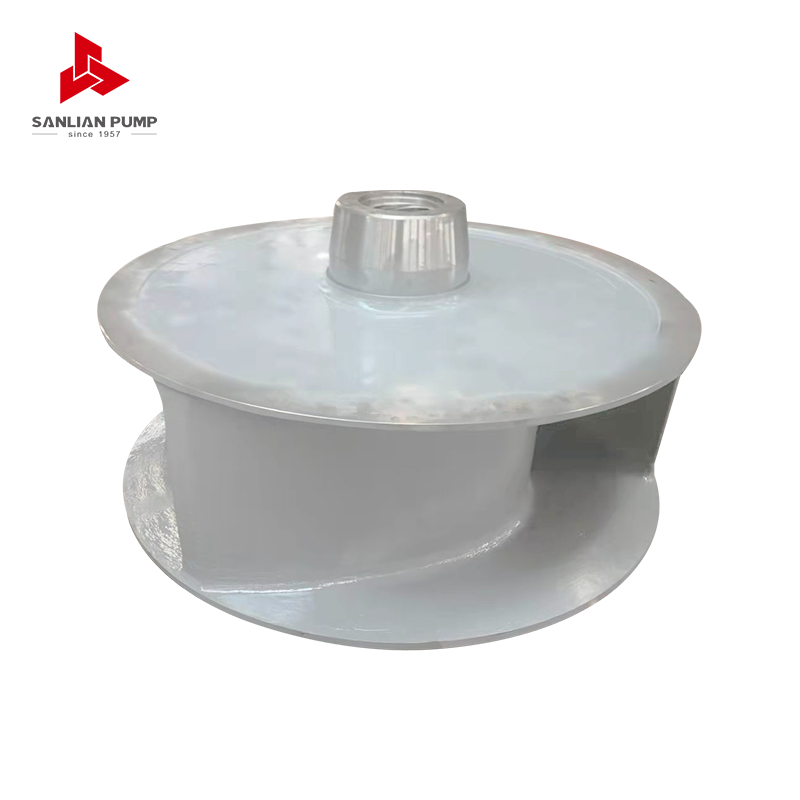
Backward-curved blades are the most widely used configuration in centrifugal pumps because they generate a stable, non-overloading power curve. As flow rate increases beyond the design point, power consumption rises slowly and predictably, preventing motor overload. Forward-curved blades generate higher head at lower speeds but produce a steeper, less stable performance curve that can lead to surging in variable-load production systems. Radial blades offer a compromise and are commonly used in slurry pumps where solids passage is more important than peak hydraulic efficiency. Matching blade angle to the expected operating point of the production process ensures the impeller consistently delivers near its best efficiency point (BEP), which minimizes wasted energy per unit of fluid moved.
Impeller Diameter and Rotational Speed
Affinity laws govern the relationship between impeller diameter, rotational speed, flow rate, head, and power consumption. These laws state that flow rate changes proportionally with speed, head changes with the square of speed, and power changes with the cube of speed. In practical terms, a 10% increase in impeller diameter or rotational speed produces a 21% increase in head but a 33% increase in power consumption. This means that simply running an impeller faster is an inefficient way to boost production output—every incremental gain in throughput comes at a disproportionately high energy cost. Selecting the correct impeller diameter for the target operating point from the outset is far more efficient than relying on speed adjustments to compensate for an undersized impeller.
Efficiency Gains Through Impeller Type Selection
Not all impellers are designed for the same duty. Selecting the correct impeller type for the fluid being handled is one of the most impactful decisions in pump system design, directly affecting both production capacity and long-term operational cost.
| Impeller Type |
Best Application |
Efficiency Advantage |
| Closed Impeller |
Clean liquids, water, light chemicals |
Highest hydraulic efficiency; minimal recirculation losses |
| Semi-Open Impeller |
Fibrous or lightly loaded slurries |
Good passage for soft solids; easier clearance adjustment |
| Open Impeller |
Heavy slurries, large solids |
Clog-resistant; maintains throughput in variable slurry conditions |
| Vortex Impeller |
Highly abrasive or stringy media |
Non-clogging; reduces wear rate in gritty applications |
| Mixed-Flow Impeller |
High flow, moderate head requirements |
Combines axial and centrifugal action for high-volume throughput |
Using a closed impeller in a slurry application, for example, leads to rapid wear of the shroud surfaces, progressive efficiency loss, and frequent unplanned maintenance—all of which reduce net production time. Conversely, using an open impeller in a clean-water application wastes energy through recirculation losses that a closed design would eliminate. Correct type selection is the foundation of impeller-driven efficiency improvement.
Material Selection and Its Impact on Sustained Output
An impeller operating in an abrasive slurry loses metal from its blade surfaces continuously. As blade profiles wear away from their designed geometry, the hydraulic efficiency of the impeller degrades—flow rate drops, head decreases, and power consumption increases for the same nominal output. In high-production mining or mineral processing environments, an impeller that begins at 82% hydraulic efficiency may drop to 65% efficiency within a few thousand operating hours if constructed from inadequate materials. That 17-point efficiency loss represents a direct reduction in throughput per kilowatt-hour of electricity consumed—a significant production cost increase.
Common Impeller Materials and Their Wear Resistance
- High-chrome white iron (26–28% Cr): The industry standard for highly abrasive mineral slurries such as iron ore, copper tailings, and phosphate. Offers a hardness of 600–700 HBN, significantly extending impeller service life compared to standard cast iron.
- Natural rubber (NR): Preferred for fine-particle, high-velocity slurries where particles are smaller than 6 mm and relatively rounded. Rubber's elasticity absorbs impact energy rather than fracturing, providing wear life equal to or exceeding chrome iron in fine-ore applications.
- Polyurethane: Used where chemical resistance and abrasion resistance must be balanced; effective in phosphoric acid slurries and saline process water environments.
- Duplex stainless steel: Applied where corrosion from aggressive chemicals is the primary degradation mechanism rather than abrasion; common in chemical processing and desalination applications.
- Ceramic-coated or tungsten carbide overlays: Used in extreme wear applications where even chrome iron is consumed too rapidly; high upfront cost is offset by dramatically extended service intervals.
Selecting the right material not only extends the interval between impeller replacements—it preserves the original hydraulic geometry for longer, sustaining the production efficiency the pump was designed to deliver throughout its service life rather than allowing a gradual decay in performance between maintenance shutdowns.
Operating at the Best Efficiency Point to Maximize Output
Every impeller has a best efficiency point (BEP)—the specific combination of flow rate and head at which the impeller converts the greatest proportion of input shaft power into useful hydraulic energy. Operating significantly above or below the BEP wastes energy, generates excessive heat, increases vibration levels, accelerates bearing and seal wear, and reduces the pump's effective production capacity. In practical terms, a pump running at 60% of its BEP flow rate may consume 85% of its rated power while delivering only 60% of the designed throughput—an extraordinarily inefficient operating condition.
Production efficiency improvements from impeller optimization are therefore closely tied to system design. A correctly sized impeller operating at or near its BEP under normal production conditions delivers the designed flow rate at the lowest possible energy cost per unit volume. When production demands change, variable frequency drives (VFDs) allow rotational speed to be adjusted to shift the operating point back toward BEP rather than throttling flow with a control valve—a practice that wastes energy by artificially imposing resistance into the system without reducing power consumption proportionally.
Impeller Trimming as a Practical Efficiency Tool
Impeller trimming—reducing the outer diameter of an impeller by machining—is one of the most cost-effective methods of adjusting pump performance to match actual system requirements without purchasing a new impeller or pump casing. When a pump is oversized for its system (a common situation when conservative design safety factors are applied), it runs to the right of its BEP, consuming excessive power and causing internal recirculation that accelerates wear. Trimming the impeller diameter shifts the performance curve downward, moving the operating point back toward BEP and reducing both energy consumption and wear rates simultaneously.
The practical limit of impeller trimming is typically around 75–80% of the original diameter; beyond this point, the blade geometry becomes distorted relative to the volute geometry, and efficiency losses from poor volute-impeller interaction outweigh the benefits of operating closer to BEP. Within this range, however, trimming can reduce power consumption by 15–25% for an oversized pump—a direct improvement in production cost efficiency without any capital expenditure on new equipment.
Preventive Maintenance Strategies That Protect Impeller Efficiency
Even a perfectly selected and correctly sized impeller loses efficiency if maintenance practices allow wear to progress undetected until failure occurs. A structured preventive maintenance program focused on the impeller and its clearances is essential for sustaining the production efficiency gains achieved through proper design:
- Monitor discharge pressure and motor current draw continuously; a steady decline in discharge pressure at constant speed indicates impeller wear and signals when intervention is needed before efficiency losses become severe.
- Adjust impeller-to-volute liner clearances at scheduled intervals in open and semi-open impeller designs; clearance growth from wear is the single fastest pathway to efficiency loss in these configurations.
- Inspect impeller blade leading edges for erosion and pitting at each planned shutdown; leading edge damage disproportionately affects inlet flow patterns and reduces BEP flow rate even when overall blade mass loss appears minor.
- Balance replacement impellers before installation; even small residual imbalance at high rotational speeds causes vibration that accelerates bearing and seal failure, reducing mean time between failures and cutting production availability.
- Keep detailed records of impeller replacement dates, measured performance data, and wear patterns; this data enables accurate prediction of future service life and allows maintenance to be planned during scheduled production downtime rather than forced shutdowns.
Quantifying the Production Efficiency Gains from Impeller Optimization
The cumulative effect of correct impeller type selection, appropriate material specification, BEP-aligned system design, and disciplined preventive maintenance can be substantial. In mining applications, optimized impeller programs have delivered documented reductions in specific energy consumption—energy consumed per tonne of material transported—of 18 to 30% compared to baseline operations using generic, poorly matched impellers running well off their design points. In water treatment, correctly trimmed impellers operating near BEP have reduced annual pump energy costs by 20–40% compared to oversized, untrimmed alternatives.
Beyond energy savings, the reduction in unplanned downtime from extended impeller service life directly increases production availability. A plant that previously experienced impeller-related pump failures every 1,800 hours can extend that interval to 4,000 hours or more through material upgrades and operating point optimization—more than doubling the productive time between maintenance events. When aggregated across a large pump fleet, these gains represent millions of dollars in additional production capacity and avoided maintenance costs annually, making impeller optimization one of the highest-return investments available in industrial fluid handling.



 English
 中文简体
中文简体 Français
 Español
 Português
 عربى
عربى

 皖公网安备34052302341647号