Why the Machine Tool Base Is the Foundation of Every Precision Operation
In any machine tool system — whether a CNC machining center, a surface grinder, a lathe, a jig boring machine, or a coordinate measuring machine — the base is not merely the structure that holds everything else together. It is the geometric and dynamic reference from which every cutting motion, every tool path, and every dimensional relationship in the finished workpiece is ultimately derived. If the base deflects under cutting load, absorbs vibration inconsistently, shifts with temperature changes, or settles unevenly on the shop floor, every other element of the machine's precision — the spindle, the linear guides, the servo drives, the feedback systems — is undermined. A machine tool is only as accurate as its foundation, and the base is that foundation.
This is why machine tool base design and manufacturing receives disproportionate engineering attention relative to its apparent simplicity. A well-designed base will maintain its geometric form within micron-level tolerances across decades of continuous production use, absorbing cutting forces and thermal gradients without transferring them as dimensional errors to the machined workpiece. A poorly designed or manufactured base — regardless of how sophisticated the machine's control system or spindle technology — will limit accuracy to levels far below what the rest of the machine is capable of delivering. Understanding what distinguishes an excellent machine tool base from an adequate one is practical knowledge for anyone specifying, purchasing, installing, or maintaining precision manufacturing equipment.
Primary Materials Used in Machine Tool Base Construction
The choice of base material is one of the most fundamental decisions in machine tool design, and it involves balancing multiple competing requirements: static stiffness, dynamic damping, thermal stability, machinability for precision surface finishing, and cost of production. Different material families offer distinct trade-off profiles, and the optimal choice depends heavily on the machine type, its intended accuracy class, and the production environment it will operate in.
Gray Cast Iron
Gray cast iron has been the dominant machine tool base material for over a century, and for good reason. Its combination of properties is exceptionally well suited to the demands of machine tool structures. Cast iron has a specific damping capacity roughly three to five times higher than structural steel, meaning it absorbs vibration energy from cutting processes and converts it to heat rather than allowing it to resonate through the structure and affect surface finish. Its compressive strength is excellent, and its graphite microstructure provides inherent lubricity that benefits slideways machined directly into the base surface. Cast iron is also dimensionally stable after proper stress-relieving treatment, and it can be precision-scraped or ground to achieve flatness and straightness tolerances in the single-micron range. Grades such as HT250 and HT300 are commonly specified for machine tool bases, with alloy additions of chromium, molybdenum, or nickel used to improve strength and hardness for more demanding applications.
Polymer Concrete and Mineral Casting
Polymer concrete — also called mineral casting or epoxy granite — has gained significant adoption in precision machine tool bases over the past three decades, particularly in grinding machines, coordinate measuring machines, and high-speed machining centers where vibration damping and thermal stability are paramount. Mineral casting is produced by combining crushed granite or basalt aggregate with an epoxy resin binder, which is cast into molds and cured at room temperature. The resulting material has damping characteristics six to ten times superior to cast iron, a low coefficient of thermal expansion, and the ability to be cast to near-net shape with embedded inserts, coolant channels, and mounting features — eliminating extensive post-casting machining. Its weakness is lower tensile strength compared to cast iron, which limits its use in applications with high tensile or bending stress concentrations.
Welded Steel Fabrications
Welded structural steel bases are used in certain large machine tools, particularly where the sheer size of the required structure makes casting impractical, or where high tensile strength is needed to resist bending loads over long spans. Steel has approximately three times the stiffness-to-weight ratio of cast iron in bending, which can be advantageous in bridge-type gantry machine structures with long overhangs. However, welded steel has very poor damping compared to cast iron — roughly one-fifth the damping capacity — and significant residual stresses from welding that must be relieved by thermal treatment to prevent long-term dimensional instability. Welded steel bases also require external damping solutions such as constrained layer damping panels or polymer concrete infill in the hollow sections to approach the dynamic performance of cast iron alternatives.
Granite
Natural granite is used as the base and reference surface material for the highest-accuracy coordinate measuring machines, surface plates, and laboratory-grade precision equipment. Granite's extremely low thermal expansion coefficient, dimensional stability over decades, absence of internal stress, and ability to be lapped to nanometer-level flatness make it uniquely suited to metrology applications. However, its brittleness, weight, sensitivity to thermal gradients, and the difficulty of machining complex shapes from solid stone limit its use to flat surface and straightedge applications rather than complex machine tool base geometries.
Structural Design Principles That Determine Base Performance
Material selection alone does not determine machine tool base performance — the structural design of the base casting or fabrication is equally critical. A well-chosen material processed into a poorly designed structure will underperform relative to a modestly specified material in an intelligently designed form. The following design principles are applied by leading machine tool engineers to maximize base stiffness, stability, and dynamic performance within practical manufacturing and cost constraints.
- Closed box sections with internal ribbing: Rather than solid sections — which are heavy and do not use material efficiently — precision machine tool bases use hollow box structures with carefully designed internal rib networks. The ribs carry shear forces between the upper and lower walls of the base, dramatically increasing bending and torsional stiffness relative to an equivalent-weight solid section. Diagonal ribs are particularly effective at resisting torsion, which is the most common and damaging deformation mode in machine tool bases under asymmetric cutting loads.
- Optimized wall thickness for casting quality: Excessively thin walls in cast iron bases cause rapid solidification and hard spots; excessively thick walls cause slow cooling, porosity, and residual stress. Most precision machine tool base castings target wall thicknesses between 15mm and 25mm, with thicker sections in areas of high stress concentration and tapered transitions to avoid abrupt section changes that create internal stress risers.
- Guideway integration: In the highest-accuracy machine designs, the guideway mounting surfaces are integral to the base casting — machined directly from the base material rather than being bolted-on sub-components. This eliminates the interface compliance and potential geometric error introduced by separate guideway attachment, and ensures that thermal gradients affect the guideway and base as a unified structure.
- Coolant and chip management integration: Modern machine tool bases are designed with integrated coolant collection sumps, chip conveyor channels, and coolant return passages cast or machined into the base structure. This prevents coolant from pooling on the base surfaces and creating uneven thermal gradients, and ensures efficient chip removal that prevents chip accumulation from causing thermal and geometric disturbances.
- Three-point support design: Machine tool bases are typically designed to be supported at three points — or at a kinematically determined set of contact zones — rather than along their full perimeter. Three-point support is statically determinate, meaning the base adopts a uniquely defined geometric position regardless of minor irregularities in the floor. Full-perimeter support forces the base to conform to the floor geometry, potentially introducing twist or warp that corrupts the machine's geometric accuracy.
Stress Relief and Aging: Why Rushing Production Destroys Long-Term Accuracy
One of the most consequential and frequently compromised steps in machine tool base production is the stress relief treatment applied after casting or welding and before precision machining. All casting processes introduce residual stresses into the base material as a result of differential cooling rates between thick and thin sections, and between the surface and core of the casting. These residual stresses are locked into the structure in a state of metastable equilibrium — they do not cause immediate visible deformation, but they will gradually release over time, causing the base to slowly change its geometric form long after it has been precision-machined and installed in the machine.
Thermal stress relief — heating the casting to 500°C to 600°C in a controlled furnace cycle, holding at temperature for a period proportional to the base's section thickness, and then cooling slowly and uniformly — permanently relaxes the majority of residual casting stress. A properly stress-relieved cast iron base will maintain its machined geometry for decades of production use. A base that has been inadequately stress-relieved will continue to move — typically at rates of 5 to 20 micrometers per year — gradually corrupting the machine's geometric accuracy in ways that are difficult to diagnose and expensive to correct. Traditional natural aging — leaving rough castings outdoors for months or years to allow thermal cycling to relieve stresses — has largely been replaced by controlled thermal treatment, but the principle remains: no precision machining should begin on a base that has not been properly stress-relieved.
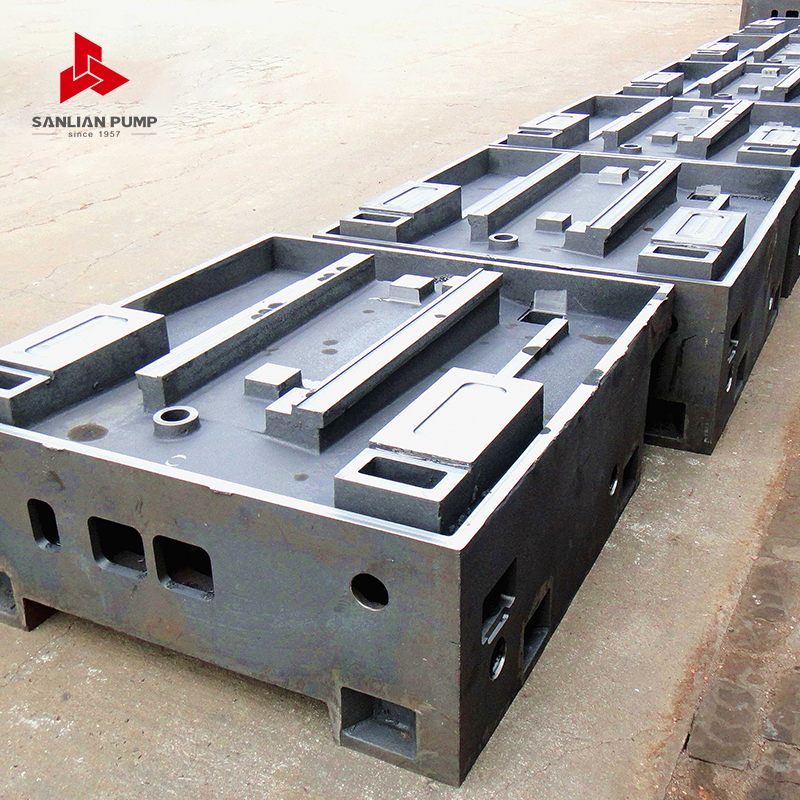
Precision Machining and Surface Finishing of Machine Tool Bases
After stress relief, the base undergoes precision machining of all functional surfaces — guideway mounting surfaces, spindle housing mounting faces, leveling pad areas, and reference datums. The sequence and method of this machining is critical: surfaces must be machined in a logical datum hierarchy that prevents accumulated error, and the base must be supported in the machining fixture in a manner that replicates its final installed support condition to avoid stress-dependent geometric errors.
Grinding and Scraping for Final Accuracy
Precision surface grinding of guideway surfaces achieves flatness tolerances in the range of 2 to 5 micrometers per 1,000mm for standard machine tools, and below 1 micrometer per 1,000mm for high-precision grades. Hand scraping — a traditional but still widely practiced technique in high-end machine tool manufacturing — can achieve and verify flatness at the sub-micron level and, uniquely, corrects bearing area distribution on slideway surfaces to ensure uniform oil film support across the full contact zone. Scraped surfaces carry a characteristic cross-hatched pattern of scraping marks that provides both oil retention and verifiable bearing area percentage, typically targeted at 70% to 85% contact for precision slideway surfaces.
Verification and Geometric Testing
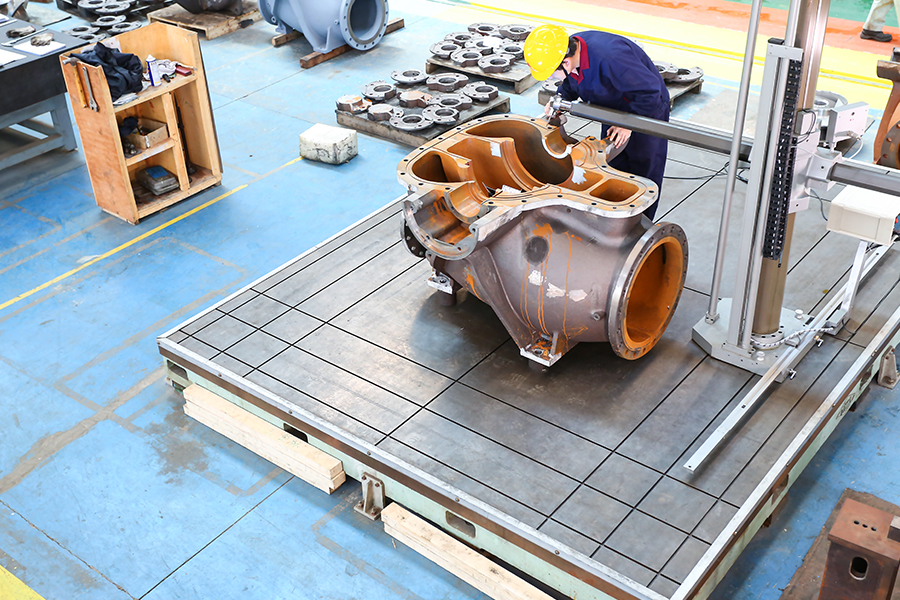
Completed machine tool bases are verified against geometric tolerance standards — typically ISO 230-1 for machine tools — using precision levels, autocollimators, laser interferometers, and granite straightedges. The tests measure straightness of guideway surfaces in both vertical and horizontal planes, flatness of mounting surfaces, squareness between reference axes, and twist along the base length. All measurements are performed in a temperature-controlled environment and corrected to a standard reference temperature of 20°C to eliminate thermal expansion errors from the geometric data. Only bases that meet all specified tolerances are accepted for assembly — any base failing these tests is returned for corrective machining or scrapping, as the cost of a non-conforming base propagating through to a finished machine is orders of magnitude greater than the cost of rejection at this stage.
Installation and Leveling: Getting the Most From a Precision Base
Even a perfectly manufactured machine tool base will fail to deliver its potential accuracy if it is incorrectly installed. Proper installation begins with floor preparation — the foundation must be capable of supporting the machine's weight without differential settlement, and in high-precision applications a dedicated reinforced concrete foundation isolated from floor vibration sources is required. The machine base is then leveled using precision leveling screws or jack bolts at the designated support points, with the leveling process monitored by a high-sensitivity precision spirit level or electronic level with resolution of 0.001mm per meter or better.
- Level the base longitudinally and transversely at each support point, iterating adjustments until the entire base is within the manufacturer's specified leveling tolerance — typically 0.02mm per 1,000mm for standard machines and 0.005mm per 1,000mm for precision grades.
- Check for twist by measuring level readings at multiple positions along the base length and correcting any diagonal height difference between diagonally opposite support points, which is the primary source of base twist after installation.
- Allow the machine to thermally stabilize in the production environment for at least 24 to 48 hours after installation before performing final geometric verification, as the base will undergo slight dimensional changes as it equilibrates to the shop floor temperature.
- Re-check leveling at scheduled intervals — typically every six to twelve months for production machines — as floor settlement, thermal cycling, and the accumulated effect of machine operation can cause the base level to drift beyond acceptable limits over time.
- In high-precision environments, install vibration isolation mounts between the base and the floor to prevent external vibration sources — foot traffic, nearby machinery, vehicle movement — from coupling into the machine and affecting surface finish and dimensional accuracy.



 English
 中文简体
中文简体 Français
 Español
 Português
 عربى
عربى

 皖公网安备34052302341647号