Two Different Hydraulic Design Philosophies
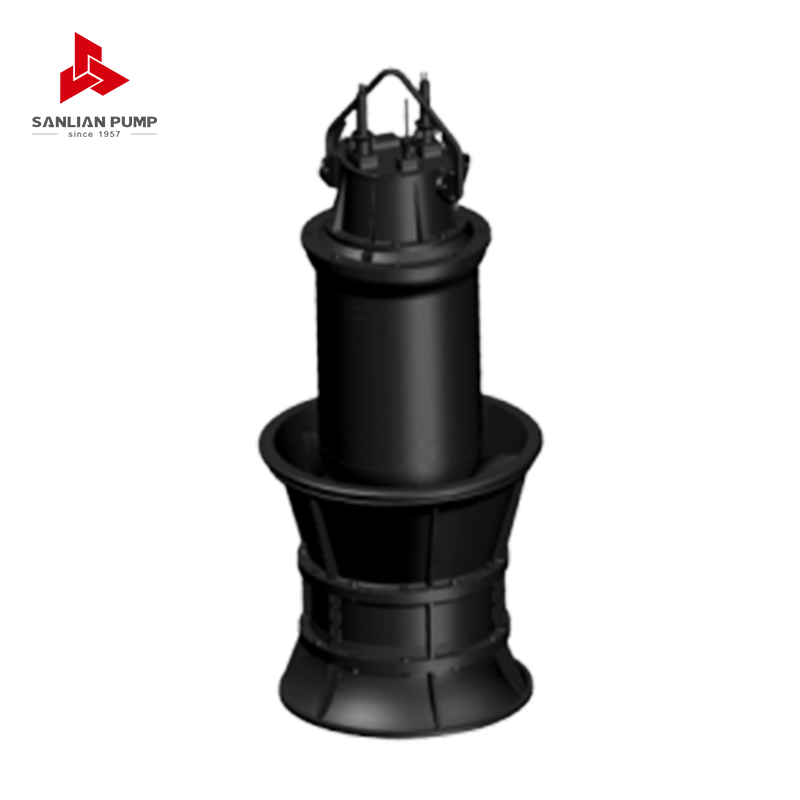
The SLQZ(H) Series Axial (Mixed) Flow Submersible Water Pump and the QW(N) Series Submersible Pump are both submersible units, but the similarity largely ends there once you look at what each pump was hydraulically designed to move. The SLQZ(H) uses either a pure axial-flow impeller (the Z designation) or a mixed-flow impeller (the H designation), both of which are engineered to move very large volumes of liquid at relatively low head. This hydraulic geometry pushes water almost straight through the impeller in the axial configuration, or at a slight angle in the mixed-flow configuration, which is why these pumps excel at high-flow, low-lift transfer rather than building pressure.
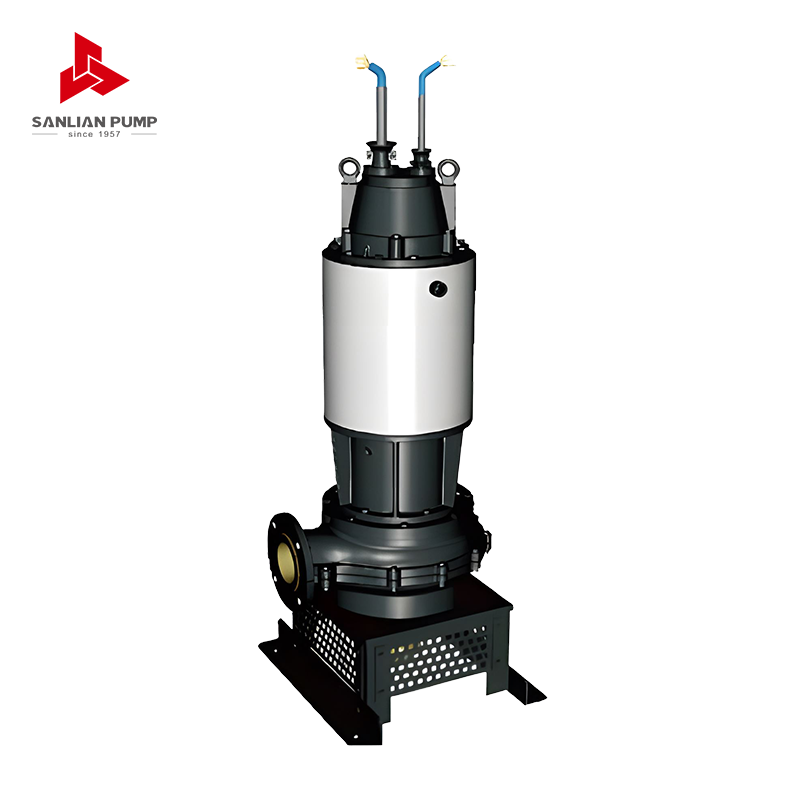
The QW(N) series, by contrast, uses a conventional or non-clogging centrifugal impeller design intended to build head through centrifugal force while also passing solids, fibrous material, and other contaminants without blocking the flow channel. This difference in impeller geometry is the root cause of nearly every practical difference between the two product lines, from head range to media compatibility to maintenance approach.
Flow and Head Range: Why One Pump Moves More Water and the Other Builds More Pressure
Axial-flow configurations within the SLQZ(H) line are generally suited to heads under roughly 10 meters, while the mixed-flow configuration extends that range to around 20 meters, with flow capacities that can reach into the thousands of cubic meters per hour in larger models. This makes the SLQZ(H) series the natural choice for large-volume water transfer tasks such as irrigation district water diversion, urban flood drainage, or circulating water supply for power plants, where the priority is moving enormous volumes of water over a short vertical lift rather than pushing it through long pipe runs or up significant elevation.
The QW(N) series operates in a different performance envelope. Because its centrifugal impeller is designed to generate head rather than maximize throughput, it is better suited to applications where the pump needs to push liquid through longer discharge piping, up a meaningful vertical lift, or against system backpressure, such as pumping sewage from a collection pit up to a treatment facility or moving wastewater across a construction site. The tradeoff is that for a given motor size, a QW(N) pump will typically move less total volume than an SLQZ(H) pump operating at its optimal low-head point.
Comparing Core Specifications and Application Fit
| Characteristic |
SLQZ(H) Axial (Mixed) Flow Pump |
QW(N) Submersible Pump |
| Impeller type |
Axial or mixed-flow |
Centrifugal, non-clogging design |
| Typical head range |
Under 10m (axial), up to ~20m (mixed) |
Moderate to high head, depending on stage design |
| Flow capacity |
Very high, suited to bulk water transfer |
Moderate, matched to application demand |
| Media compatibility |
Clean water or liquids with low suspended solids |
Sewage, wastewater with solids and fibrous material |
| Maintenance structure |
Pull-out structure for rapid inspection without disturbing pipelines |
Designed for solids clearance, seal and impeller access for clog removal |
| Typical applications |
Irrigation, municipal water projects, drainage, power plant circulation |
Municipal sewage, industrial wastewater, construction dewatering |
Media Handling: Clean Water Versus Solids-Laden Flow
The SLQZ(H) series is optimized for clean water or liquids with physical and chemical properties similar to clean water, including low levels of suspended solids. This hydraulic configuration and structural design are not intended for transporting high-solid-content slurries or abrasive materials; feeding heavily contaminated or particulate-laden liquid through an axial or mixed-flow impeller risks accelerated wear on the impeller vanes and reduced hydraulic efficiency over time, since the flow passages are not shaped to pass solids or fibrous debris without disruption.
The QW(N) series takes the opposite design approach. Its non-clogging hydraulic profile and wider flow passages are specifically shaped to allow solid particles and stringy or fibrous material to pass through without jamming the impeller, which is the defining engineering challenge this series was built to solve. Where a conventional centrifugal pump would clog quickly when handling municipal sewage or industrial wastewater containing rags, fibers, or debris, the QW(N) impeller geometry and cutting or shredding features (depending on the specific model configuration) are designed to maintain flow continuity under exactly these conditions.
What Happens When the Wrong Pump Is Chosen for the Media
Installing an SLQZ(H) pump in a flow stream carrying meaningful solids content typically results in gradually declining efficiency, increased vibration as debris interferes with impeller balance, and eventual impeller damage that shows up first as reduced flow output rather than sudden failure. Conversely, specifying a QW(N) pump for a pure high-volume clean-water transfer task where head requirements are minimal often means paying for pumping capability the application doesn't need, while getting less total flow throughput than an axial or mixed-flow design would deliver from a comparably sized motor.
Structural and Maintenance Differences Worth Understanding
One of the defining structural features of the SLQZ(H) series is its pull-out design, which allows the pump unit to be lifted out of its installation for inspection or maintenance without disturbing the connected pipeline. In large water transfer stations where downtime translates directly into lost irrigation capacity or delayed drainage, this feature significantly shortens maintenance windows and reduces the labor involved in routine servicing, since technicians are not required to disconnect and reseal pipe joints every time the pump needs attention.
The QW(N) series is built around a different maintenance priority: managing the wear and clogging risk that comes with handling solids-laden media. These pumps are typically designed with accessible impeller housings or inspection points that allow operators to clear blockages or inspect for wear on the impeller and seal areas resulting from abrasive or fibrous content passing through the pump. Mechanical seal integrity is a particular focus in this series, since sewage and wastewater applications place continuous stress on the seal interface that clean-water applications generally do not.
- SLQZ(H) maintenance planning centers on periodic inspection of the impeller and bearing condition, since the primary wear driver is continuous operation rather than abrasive media contact.
- QW(N) maintenance planning centers on seal condition monitoring and periodic clearing of accumulated debris, since the media itself is the dominant source of component wear and potential blockage.
Advantages and Limitations of Each Series
The SLQZ(H) series offers a clear advantage in raw throughput per unit of installed power when the head requirement is low and the water is relatively clean, along with a maintenance-friendly pull-out structure that minimizes downtime for large installations. Its limitation is a narrow media tolerance; it is not the right choice once suspended solids, fibrous debris, or abrasive particulate become a regular part of the flow stream, and it is also not well suited to applications requiring significant head, since its hydraulic design trades pressure-building capability for flow volume.
The QW(N) series offers the advantage of reliable operation in solids-laden and fibrous media where a conventional or axial-flow pump would clog or wear prematurely, along with the ability to generate meaningful head for applications that need to move liquid through longer pipe runs or up greater elevation. Its limitation is lower raw flow throughput compared to an axial or mixed-flow pump of similar power rating when operating in genuinely clean, low-head conditions, meaning it is not the most efficient choice when the application does not actually require solids-handling capability.
Choosing Between the Two for a New Installation
The practical decision between these two series comes down to answering two questions before anything else: what is actually in the fluid being pumped, and what head is required to move it to its destination. If the application involves large volumes of clean or lightly contaminated water at low lift, such as irrigation supply, drainage, or plant circulation water, the SLQZ(H) series delivers better volumetric efficiency and lower long-term wear. If the application involves sewage, industrial wastewater, or any fluid stream likely to carry solids or fibrous material, along with a need to overcome meaningful head, the QW(N) series is the appropriate choice regardless of how much total flow volume the site nominally requires.
Buyers uncertain about solids content in their specific application, such as stormwater systems that may carry debris intermittently rather than continuously, should evaluate the worst-case media condition the pump will encounter rather than the average condition, since an SLQZ(H) unit installed on the assumption of clean water can suffer accelerated impeller wear the first time a debris-heavy storm event pushes solids through the system.


 English
 中文简体
中文简体 Français
 Español
 Português
 عربى
عربى

 皖公网安备34052302341647号